
 Operators Guide



Configure events for Google Campaign Manager 360
Google Campaign Manager 360 (CM360) is an ad management platform for measuring and attributing advertising campaigns. Offline conversions are conversions that happen away from your website, such as an in-store purchase, that your brand sends back to CM360 tied to the Google ad click that led to them. Search Ads 360 uses the delivered value of these conversions — for example, a predicted lifetime value — to optimize bidding.
Send offline conversions to Google Campaign Manager 360 (CM360) so that Search Ads 360 can optimize bidding on the real, delivered value of a conversion. Each row returned by your query is sent as a single conversion, tied to the Google Click ID (gclid) of the ad click that led to it. A common use is sending a predicted lifetime value as the conversion value, rather than the order total alone.
Amperity sends conversions to CM360 through the Google Data Manager API. There is no audience or list involved — every orchestration submits a new batch of conversions.
Caution
Amperity records consent as granted at the request level for every conversion in a batch. The connector does not send per-customer consent signals, so exclude any customer who has opted out of ad tracking from the query that returns results for Google Campaign Manager 360.
Beta
The Google CM360 connector is currently in beta. Contact your Amperity representative to learn more.
How this destination works
When a customer clicks a Google ad, a Google Click ID (gclid) is captured. If that customer later converts away from your website — for example, an in-store purchase — CM360 has no record of that conversion. Amperity sends the conversion with the original gclid attached, and CM360 matches it back to the click so that Search Ads 360 can attribute and bid on the conversion.
CM360 matches conversions in the background, and the process can take a long time — from minutes to days. Because an orchestration cannot wait that long, Amperity reports a conversion as delivered once CM360 accepts the batch.
Important
A successful orchestration means CM360 accepted the conversions, not that it has matched and credited them. Confirm final, per-conversion outcomes in the Campaign Manager 360 interface.
Get details
Review the following details before configuring credentials for Google Campaign Manager 360 and before configuring Amperity to send offline conversions to Google Campaign Manager 360.

|
Configure Google Campaign Manager 360
|
|
|
Credential settings Refresh token
|
|
|
Required configuration settings Floodlight configuration ID
Floodlight activity ID
|
Configure credentials
Configure credentials for Google Campaign Manager 360 before adding a destination.
An individual with access to Google Campaign Manager 360 should use SnapPass to securely share “Refresh token” details with the individual who configures Amperity.
To configure OAuth

|
From the Settings page, select the Credentials tab, and then click the Add credential button. |
|
In the Credentials settings dialog box, from the Plugin dropdown, select “Google CM360”. Note Amperity provides several Google connectors. Select “Google CM360” to send offline conversions to Google Campaign Manager 360. Assign the credential a name and description that ensures other users of Amperity can recognize when to use this destination. |
|
The settings that are available for a credential vary by credential type. For the “google-cm360” credential type, configure settings, and then click Save. Refresh token
|
Add destination
Use a sandbox to configure a destination for Google Campaign Manager 360. Before promoting your changes, send a sample audience, and then verify the results in Google Campaign Manager 360. After verifying the end-to-end workflow, push the destination from the sandbox to production.
To add a destination for Google Campaign Manager 360
|
|
Open the Destinations page, select the New destinations button, and then select Orchestration. To configure a destination for Google Campaign Manager 360, do one of the following:
|
|
|
Select the credential for Google Campaign Manager 360 from the Credential dropdown, and then click Continue. Tip Amperity validates the connection when the destination is saved. If the connection cannot be validated, an error is shown and the destination is not saved. |
|
|
In the “Destination settings” dialog box, assign the destination a name and description that ensures other users of Amperity can recognize when to use this destination. Configure business user access By default a destination is available to all users who have permission to view personally identifiable information (PII). Enable the Admin only checkbox to restrict access to only users assigned to the Datagrid Operator and Datagrid Administrator policies. Enable the PII setting checkbox to allow limited access to PII for this destination. Use the Restrict PII access policy option to prevent users from viewing data marked as PII anywhere in Amperity and from sending data to downstream workflows. |

|
Configure the following settings, and then click “Save”. Floodlight configuration ID
Floodlight activity ID
|

|
After configuring this destination users may use orchestrations to send query results Google Campaign Manager 360. |

|
Validate the audience with Google Campaign Manager 360 by using a sample audience with a very small membership. For example: 10 or 100 members or the minimum audience size recommended by Google Campaign Manager 360. Send the sample audience to Google Campaign Manager 360 and verify the sample audience is correct in Google Campaign Manager 360. Make adjustments if necessary. Only send full audiences after validation is complete. |
Build a query
Use a query to return one row per offline conversion to send to Google Campaign Manager 360. Each row must include a Google Click ID (gclid), a conversion timestamp, a conversion value, and a currency code. You can also include an order ID, which CM360 uses to deduplicate conversions that are re-sent across repeated runs.
The gclid comes from your online events or ad-click data, not from a standard Amperity table. Join that data to your transaction data to build each conversion.
Review the Conversion fields section for the columns your query must and may return.
Bound the query to recent conversions so each orchestration sends new conversions instead of re-sending history; choose a window that matches how often the orchestration runs. A query that returns a collection of recent conversions for use in Google Campaign Manager 360 is similar to:
 1SELECT
 2  oe.gclid AS gclid
 3  ,ut.order_datetime AS conversion_timestamp
 4  ,ut.order_revenue AS conversion_value
 5  ,'USD' AS currency_code
 6  ,ut.order_id AS order_id
 7FROM Unified_Transactions ut
 8JOIN Online_Events oe ON ut.amperity_id = oe.amperity_id
 9WHERE oe.gclid IS NOT NULL
10  AND ut.order_datetime > (CURRENT_DATE - interval '7' day)
where:
gclid is the Google Click ID from your online events or ad-click data. The
WHEREclause keeps only rows that have one, because a conversion without a gclid cannot be sent.conversion_timestamp must be an ISO 8601 instant with a UTC offset, such as
2026-07-10T12:00:00Z. Amperity sends it as returned by your query.conversion_value is the value CM360 bids on. To bid on delivered value, such as a predicted lifetime value, send that value here in place of the order total.
currency_code is a valid ISO 4217 currency code — for example,
USD— that matches the currency of conversion_value.order_id is the deduplication key. Send a stable value so that repeated sends of the same conversion are not double-counted.
Data validation
Amperity validates your data in two stages — it checks the dataset for the required columns before sending anything, and then it validates each row as it builds the batch. These two stages fail differently, and the difference matters when you debug an orchestration.
Before sending, Amperity confirms that the query returns every required column: gclid, conversion_timestamp, conversion_value, and currency_code. If any required column is absent from the query results, the orchestration fails immediately without sending any conversions and reports Dataset validate failed. Please check the input field names and types match documented requirements. Correct the query so that it returns every required column, and then run the orchestration again.
For each row, Amperity then drops rows that CM360 would reject, so that one invalid row does not stop the rest of the batch. Dropped rows are reported as failed with the reason, and the remaining rows are sent. A row is dropped when:
a required column is present but empty in that row.
conversion_value is present but is not a number.
Column names are matched without regard to capitalization.
Conversion fields
The following table describes each column Amperity sends to Google Campaign Manager 360. A query must return columns with the same name as listed in the “Amperity name” column; Amperity maps them to the Data Manager field names automatically.
Amperity name |
Data Manager field |
Description |
|---|---|---|
gclid |
adIdentifiers.gclid |
Required The Google Click ID that identifies the ad click the conversion is attributed to. Every conversion must include a gclid; a conversion that cannot be tied to a click cannot be sent. |
conversion_timestamp |
eventTimestamp |
Required When the conversion happened. CM360 requires an ISO 8601 instant with a UTC offset — for example, |
conversion_value |
conversionValue |
Required The value of the conversion, as a number. Rows whose value cannot be read as a number are dropped. Send a predicted lifetime value here to have Search Ads 360 bid on delivered value. |
currency_code |
currency |
Required The currency that conversion_value is expressed in, as a three-character ISO 4217 code. |
order_id |
transactionId |
Optional A deduplication key. When the same conversion is re-sent across repeated runs, CM360 collapses rows with the same order ID into one so the conversion is not counted twice. |
Delivery and results
CM360 accepts a batch of conversions almost immediately and then matches them in the background over a window that can range from minutes to days. Amperity treats a conversion as delivered once CM360 accepts the batch.
A successful orchestration means CM360 accepted the conversions, not that it matched and credited them. Confirm final, per-conversion outcomes in the Campaign Manager 360 interface.
Per-conversion failures are reported on a best-effort basis. Amperity reports the failures that CM360 returns quickly — such as an invalid or duplicate click ID — as failed rows in the orchestration’s error log. Failures that CM360 surfaces only later do not appear in the orchestration.
Amperity automatically splits large sends into batches of 2,000 conversions. This is not something you configure.
Conversions cannot be deleted or retracted once submitted. CM360 offers no way to take back a conversion, so test with care.
Workflow actions
A workflow will occasionally show an error that describes what prevented a workflow from completing successfully. These first appear as alerts in the notifications pane. The alert describes the error, and then links to the Workflows tab.
Open the Workflows page to review a list of workflow actions, choose an action to resolve the workflow error, and then follow the steps that are shown.
|
|
You may receive a notifications error for a configured Google Campaign Manager 360 destination. This appears as an alert in the notifications pane on the Destinations tab. 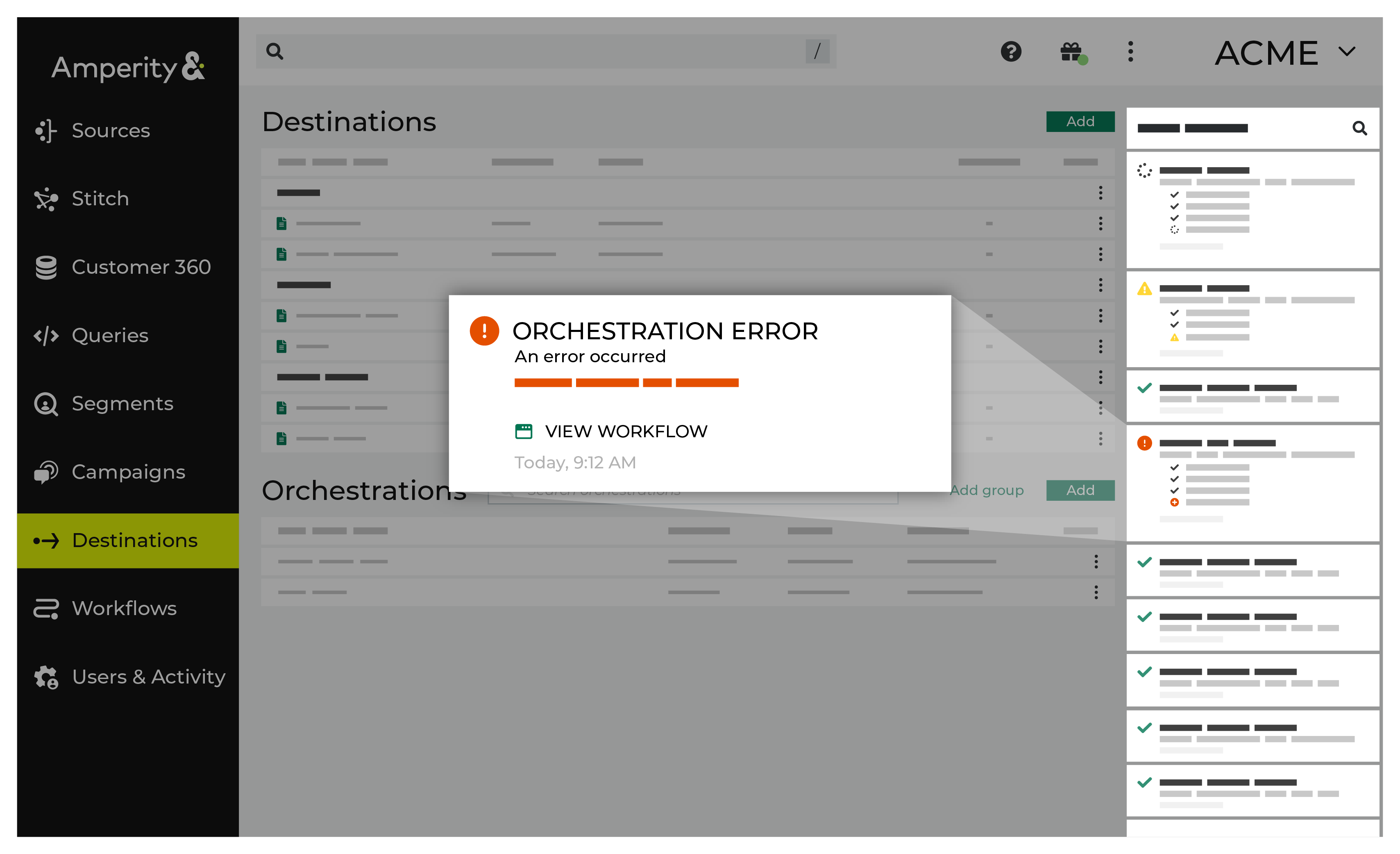
If you receive a notification error, review the details, and then click the View Workflow link to open this notification error in the Workflows page. |
|
|
On the Workflows page, review the individual steps to determine which steps have errors that require your attention, and then click Show Resolutions to review the list of workflow actions generated for this error. 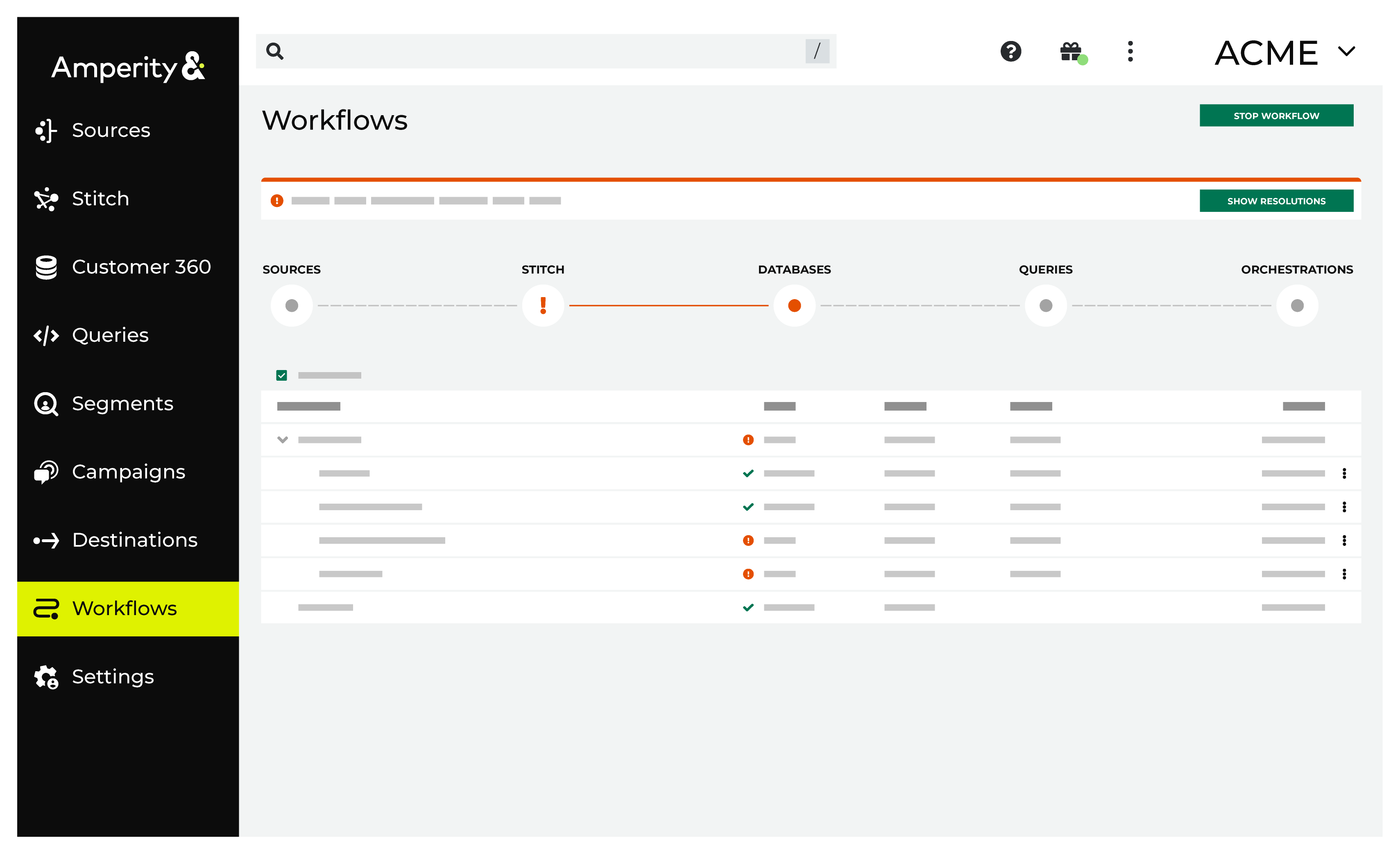
|
|
|
A list of individual workflow actions are shown. Review the list to identify which action you should take. Some workflow actions are common across workflows and will often be available, such as retrying a specific task within a workflow or restarting a workflow. These types of actions can often resolve an error. In certain cases, actions are specific and are shown when certain conditions exist in your tenant. These types of actions typically must be resolved and may require steps that must be done upstream or downstream from your Amperity workflow. |
|
|
Select a workflow action from the list of actions, and then review the steps for resolving that error. After you have completed the steps in the workflow action, click Continue to rerun the workflow. |
Note
Connection problems are caught when the destination is saved: Amperity submits a single test conversion to CM360 in a validate-only mode that writes nothing. If the check fails, the connected Google account may not be authorized, or the Floodlight configuration ID or Floodlight activity ID may be wrong or belong to an account the connected account cannot reach. During an orchestration, CM360 reports per-conversion failures by reason — an invalid or duplicate click ID, a malformed timestamp, or an unrecognized currency — and Amperity records them as failed rows with CM360’s own explanation in the error log.
Google Data Manager API reference
Amperity sends conversions to Google Campaign Manager 360 using the Google Data Manager API
. Conversions are submitted through the events:ingest method.