
 User Guides



Product affinity
Product affinity is a predictive model that identifies which customers are likely to purchase next using a combination of historical purchase data and lookalike audiences. The predicted affinity model outputs a database table with a ranked list of customers by product affinity and three recommended audience sizes.
Amperity models product affinity for any product taxonomy that has between 20 and 2000 unique values, such as brand, category, subcategory, color, size, season, and style. Product affinity modeling analyzes:
Historical data to identify customers who have purchased a product in the past and are likely to do so again.
Lookalike audiences to identify customers who have not purchased a product, but are likely to buy because they are similar to customers who have purchased.
Amperity Learning Lab
Product affinity predicts which customers are most likely to purchase from specific product categories.
Open Learning Lab to learn more about predicted affinity . Registration is required.
Use cases
The product affinity model enables support for marketing campaigns that benefit from knowing a customer’s preferences across product categories, including:
Recommended audience sizes
A recommended audience is a feature of product affinity modeling that answers the following question: “Which audience size grows revenue over the next 30 days?” Product affinity modeling answers this question with small, medium, and large recommended audience sizes. A recommended audience predicts future purchasers over the next 30 days.
Recommended audience sizes are calculated using customer transaction data over a 30-day window. A purchase curve is generated, along with corresponding audience sizes that show what size audience would have been required to capture 50%, 70%, and 90% of purchases for a given product over the previous 30 days.
Audience sizes are inclusive of all smaller audience sizes.
A medium audience size (70%) includes all of your customers who are in the small audience size (50%).
A large audience size (90%) includes all of your customers who are in the small and medium audiences.
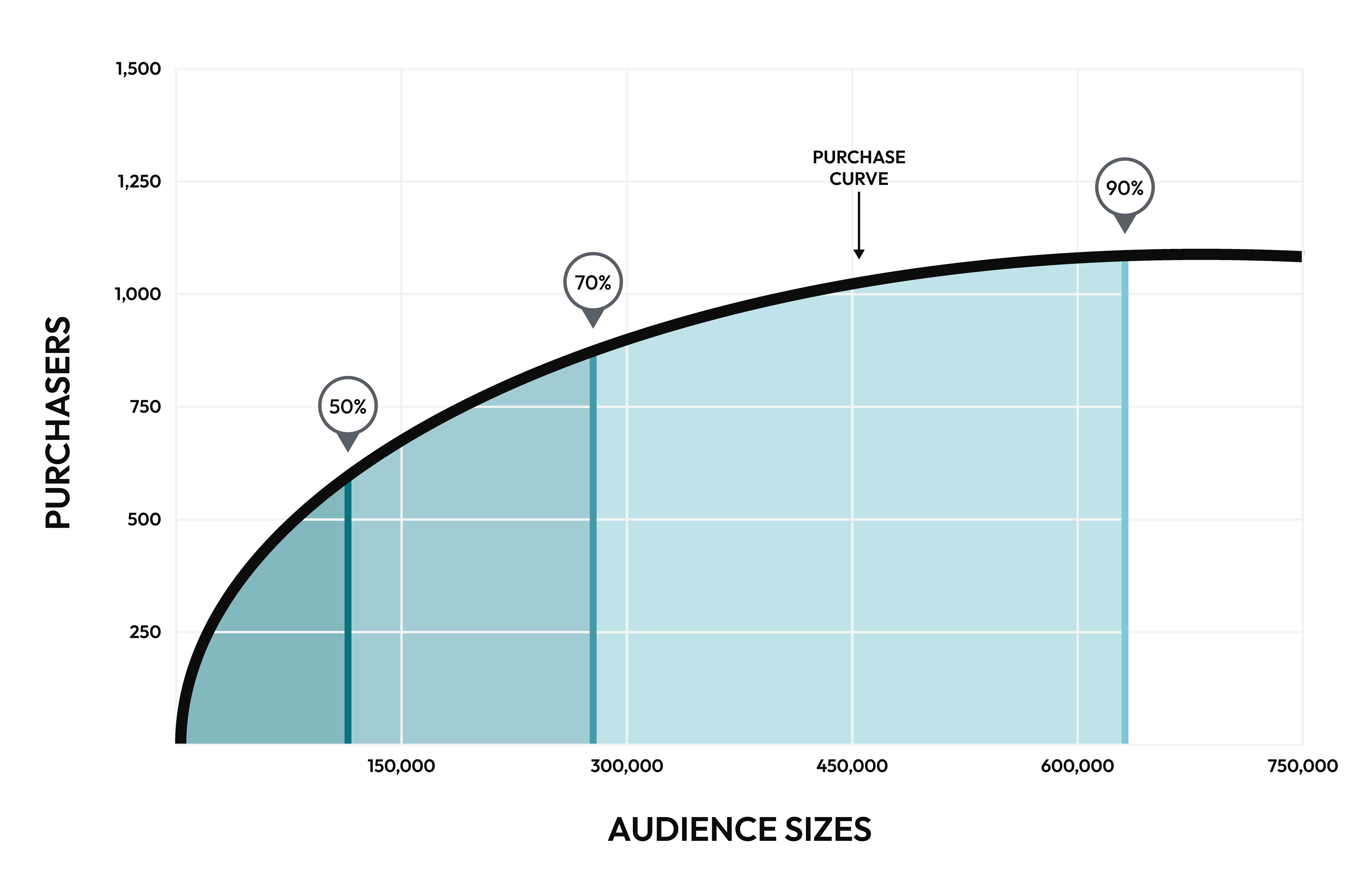
Recommended audience sizes identify customers who are most likely to purchase. Use recommended audience sizes to:
Engage with customers for product-specific sends, such as clearance sale and new arrival announcements
Define more valuable campaigns to grow revenue for specific product categories
Drive up conversion rates
Drive down opt-outs
Determine categories, products, and trends that resonate with key segments
Attributes for recommended audience sizes are available from the Predicted Affinity table:
Attribute Name |
Description |
|---|---|
Audience Size Small |
A small audience size is predicted to include ~50% of future purchasers and to include the fewest number of non-purchasers. Tip A small audience size helps prevent wasted spend and reduces opt-outs. |
Audience Size Medium |
A medium audience size is predicted to include ~70% of future purchasers and to include a moderate number of non-purchasers. |
Audience Size Large |
A large audience size is predicted to include ~90% of future purchasers and to include a high number of non-purchasers. |
Combine audience size attributes with product attributes to build audiences for a specific product categories, classes, or brands. Access these attributes directly from the Segment Editor.
Customer ranking
Use customer ranking to define an audience using the top N customers. Use customer ranking as an alternate to recommended audience sizes when an audience is too large (or small) or if a recommended audience size is unavailable for a specific product or category.
Customer ranking identifies the top N customers who are most likely to purchase. Use customer ranking to:
Provide an alternative to a recommended audience size, such as when a recommended audience size is unavailable for a specific product or category
Serve targeted product messages to defined audiences
Identify first-time buyer personas
Drive up conversion rates
Drive down opt-outs
The Ranking attribute in the Predicted Affinity table ranks customer scores by product. A rank that is less than or equal to X provides the top N customers with an affinity for this product. Combine this attribute with the Product Attribute attribute to build customer rankings for a specific product category, class, or brand.