
 Operators Guide



Configure destinations for Viant DSP
Viant DSP is a demand-side platform (DSP) that enables programmatic advertising campaigns across display, video, connected TV (CTV), audio, and native channels. Viant uses household-level identity that is linked to real people and real households to deliver and measure advertising that reaches specific customers across devices and channels. Audience segments built in Viant DSP can target customers using hashed emails, phone numbers, IP addresses, mobile device IDs, or cookie IDs.
Use Amperity to build audience segments and send them to Viant DSP for use in programmatic advertising campaigns. Amperity syncs hashed identifier data, such as emails, phone numbers, IP addresses, mobile device IDs, or cookie IDs, to first-party audience segments in Viant DSP, where they become targetable in DSP campaigns.
Note
This destination uses the VDP Connect API .
How this destination works
Amperity sends audience data to Viant DSP using an incremental workflow. Each run sends only new or changed records. Amperity creates the audience segment in Viant DSP automatically if it does not already exist.
A Viant DSP destination works like this:

|
AUTHENTICATE Amperity authenticates to Viant DSP using an OAuth2 refresh token. Amperity exchanges the refresh token for a short-lived access token, which is used for all API requests in the workflow. |
||||||||
|
RESOLVE AUDIENCE SEGMENT Amperity looks up the audience segment by name using the GET /v1/audiences endpoint, paginating through all results until a match is found. If the segment does not exist, Amperity creates it using the POST /v1/audiences endpoint with the configured account ID, advertiser ID, and identifier type. New segments start with INACTIVE status and activate after they accumulate at least 1,000 matched records. Important The segment data type cannot be changed after the segment is created. To use a different identifier type, configure a new segment name. |
||||||||

|
NORMALIZE AND HASH IDENTIFIERS Amperity normalizes and hashes each value in the identifier column before sending it to Viant DSP.
|
||||||||

|
SEND ADDITIONS Amperity sends new audience members to Viant DSP using the POST /v1/audiences/{id}/data endpoint in batches of up to 50,000 rows. Batches run in parallel. Viant DSP processes data every 10 minutes and updates segment status after each processing cycle. Members already present in Viant DSP from a prior run are counted as cached rows and are not re-sent. |
||||||||

|
SEND DELETIONS AND END WORKFLOW When audience members are removed from the segment in Amperity, Amperity sends a deletion request to Viant DSP using the PUT /v1/audiences/{id}/data endpoint. Note Deletions are processed asynchronously by Viant DSP and take effect within 24 hours. The workflow ends after all additions and deletions are sent. |
Get details
Review the following details before configuring credentials for Viant DSP and before configuring Amperity to send audience segments to Viant DSP.

|
Credential settings Refresh token
|
|
|
Required destination settings Account ID
Advertiser ID
|
|
|
Required orchestration settings Audience name
Identifier type
Audience primary key
|
|
|
A query or segment that returns an identifier column containing the identifier values to send to Viant DSP. The identifier type must match the Identifier type setting. |
Configure credentials
Configure credentials for Viant DSP before adding a destination.
An individual with access to Viant DSP should use SnapPass to securely share “refresh token” details with the individual who configures Amperity.
To configure credentials for Viant DSP
|
|
From the Settings page, select the Credentials tab, and then click the Add credential button. |
|
|
In the Create credential dialog box, do the following:
|
|
|
The settings that are available for a credential vary by credential type. For the “viant-dsp” credential type, configure settings, and then click Save. Refresh token
|
Add destination
Use a sandbox to configure a destination for Viant DSP. Before promoting your changes, send a sample audience, and then verify the results in Viant DSP. After verifying the end-to-end workflow, push the destination from the sandbox to production.
To add a destination for Viant DSP
|
|
Open the Destinations page, select the New destinations button, and then select Orchestration. 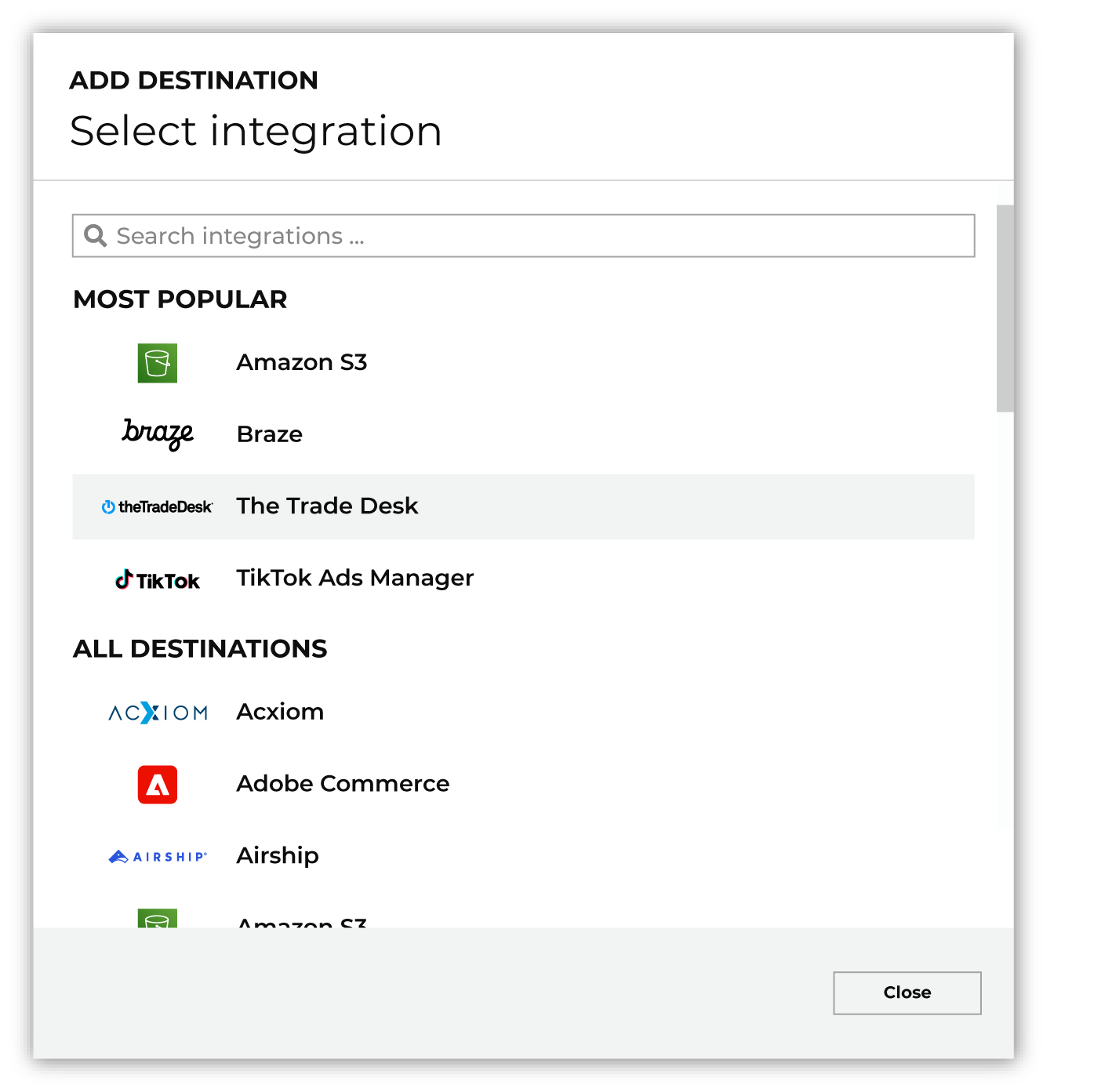
To configure a destination for Viant DSP, do one of the following:
|
|
|
Select the credential for Viant DSP from the Credential dropdown, and then click Continue. Tip Amperity validates the connection when the destination is saved. If the connection cannot be validated, an error is shown and the destination is not saved. |
|
|
In the “Destination settings” dialog box, assign the destination a name and description that ensures other users of Amperity can recognize when to use this destination. Configure business user access By default a destination is available to all users who have permission to view personally identifiable information (PII). Enable the Admin only checkbox to restrict access to only users assigned to the Datagrid Operator and Datagrid Administrator policies. Enable the PII setting checkbox to allow limited access to PII for this destination. Use the Restrict PII access policy option to prevent users from viewing data marked as PII anywhere in Amperity and from sending data to downstream workflows. |
|
|
Configure the following settings, and then click “Save”. Account ID
Advertiser ID
Audience name (Required at orchestration)
Identifier type (Required at orchestration)
Audience primary key
|
|
|
After configuring this destination users may use:
|

|
Validate the audience with Viant DSP by using a sample audience with a very small membership. For example: 10 or 100 members or the minimum audience size recommended by Viant DSP. Send the sample audience to Viant DSP and verify the sample audience is correct in Viant DSP. Make adjustments if necessary. Only send full audiences after validation is complete. |